Thursday, September 11, 2014


Some mornings 
you've got to run like an antelope out of control

Lek-Lek's Birthday in Manjuyod (Mon-hoo-yod)


Different island, different fishing boat setups


Lauren and I traveled to the neighboring island of Negros to celebrate the birthday of our dear friend and fellow volunteer Alessandra, aka Lek-Lek. We spent the afternoon on a stilted house in the middle of a crystal clear sandbar which is part of her LGU's tourism projects.

Even though this is our neighboring island it took a quick 12 hours to get there.  In order - 1 bus, 2 tricycles, 1 ferry, 1 tricycle, 1 taxi and 2 more buses.  Whats surprising however is this cost us around $12 per person for all of these modes of transportation.


This woman, this specimen of posture, has the stance down perfect for Filipino sweeping which has it's origins in Spanish bullfighting.


Negros is known as the sugar cane capital of the Philippines 

The plantations here are grander on scale than anything we have on our island, it's a beautiful site.  With this beauty however brings to mind the brutal truth of child labor.  It is a strange feeling to be aware of the social problems that lie in the background.


The coast line where we were visiting was breath taking.  We took a boat out to a sand bar area where nipa huts had been built on stilts. The water was crystal clear, when the tide was at a low point it was just waist deep and as the afternoon past the tide came in but we were all able to still stand comfortably. 


Meg, Jack, and Lek-Lek making the jump.


It was a wonderful day full of laughter with other volunteers, beautiful weather during the rainy season and a sense of pure serenity from our surroundings.  It's moments like these that help us get through the lows.


After another wonderful evening with friends it was time to take the trip back. Planes trains and automobiles, better have my donuts.


It's Christmas Time in Philip-pines, Nanay's cooking' Adobo and Swamp-cabbage greens

It's almost September so that means it's time to decorate the tree. There really are only two seasons in the Philippines; rainy season and Christmas.

Thursday, September 4, 2014

Banate Bay Boat Launching Ceremony


No prefabrication happening here

The Provincial government donated materials for the fisherfolk to build boats in our community after typhoon Yolanda hit last year. Having just been finished, the official launching was held recently for two different municipalities along our bay. 

These included Anilao (where Lauren works) and Barotac Nuevo (the neighboring municipality).  Some of these boats are larger than others and some have motors and some don't. What's amazing is all of these were hand made by the fisherfolk. It is an art form that is still very much alive within the communities. 


Livelihoods & Policy Writeshop


Youth livelihood training in the neighboring municipality


World Vision Production of Child's Rights Policy Writing Workshop

I work with the non-governmental organization World Vision. The mission we are working on here in the Visayas is to fight against child labor, especially here in the sugarcane planting region where we live. Not only are there local sugarcane producers here, but large plantations of sugarcane owned by one family which promote an environment in which families are forced to have their children join them in the field. This is the only way some families can produce enough yield to earn enough money to live off.  

This two day event was designed to teach local partners in the communities we work in how to create and write local ordinances covering children, their rights to education, and freedom from being subjected to labor.


Intrupahan Beach Trip 2


The most beautiful places in the Philippines can be located just around the corner. 

Our nearest swimmable waters are a mere 1 hour away, but are technically still part of our municipality. It is a beautiful walk through a series of 8 different coastal communities.

When the tide is out there is a small sand beach, covered in seashells and rocks that have been smoothed from the continuous current.  The nipa huts (indigenous habitat) provide a shady escape from the sun while the numerous coconut trees provide a perfect snack. Everyone, even the local dogs, love the coconut!!!


Monday, September 1, 2014

Kitchen Life


Pizza Night With Real Mozzarella and Sugar Free Marinara Sauce


Pesto with tomato and sweet potato

With the abundance of basil we were able to make a modified version of pesto - parmesan cheese from the city and minus the pine nuts makes for a pretty good sauce to put on bread.  Yeast is available in the market so tonight we will be trying out for the first time to make bread over a charcoal fire.  With the readily available tomatoes, garlic, onion and bell peppers we should have a pretty decent pizza/flat bread.


Cinnamon and sugar

Recipes 

Tortilla Recipe

2 cups flour
1tsp baking powder
1tsp salt
dash of cinnamon
1/4c oil
1/2c warm water

Mix flour, baking powder, salt and cinnamon together.  Using a pastry knife or fork stir in the oil.  Make sure the mixture is crumply.  Add the warm water.  Let sit for 1 hour.  Divide dough into 16 balls, roll out and cook on a griddle for 30 seconds on each side.


Falafel Recipe

(1) can chickpeas
1 cup bean sprouts
2 small red onions
1/2 head roasted garlic
1 bunch green onions
5 calamansi (juiced)
1TBS cumin
1tsp cayenne pepper
1tsp nutmeg
salt and pepper to taste

1 egg
1/4c flour plus additional flour for coating
1/4c bread crumbs

Blend all ingredients in blender or food processor except for egg, flour and bread crumbs.  Once the ingredients are blended stir in the egg, flour and bread crumbs.  Once the batter is mixed form balls - the batter should stay in this form.  Add more flour or bread crumbs if it doesn't hold.  Roll the ball in flour to coat.  Fry balls until golden brown.

Top with pickles, green onions, roasted tomatoes and garlic


Merkado Fresh - A Few Thoughts On Our Community


Living close to the market has it's advantages. 

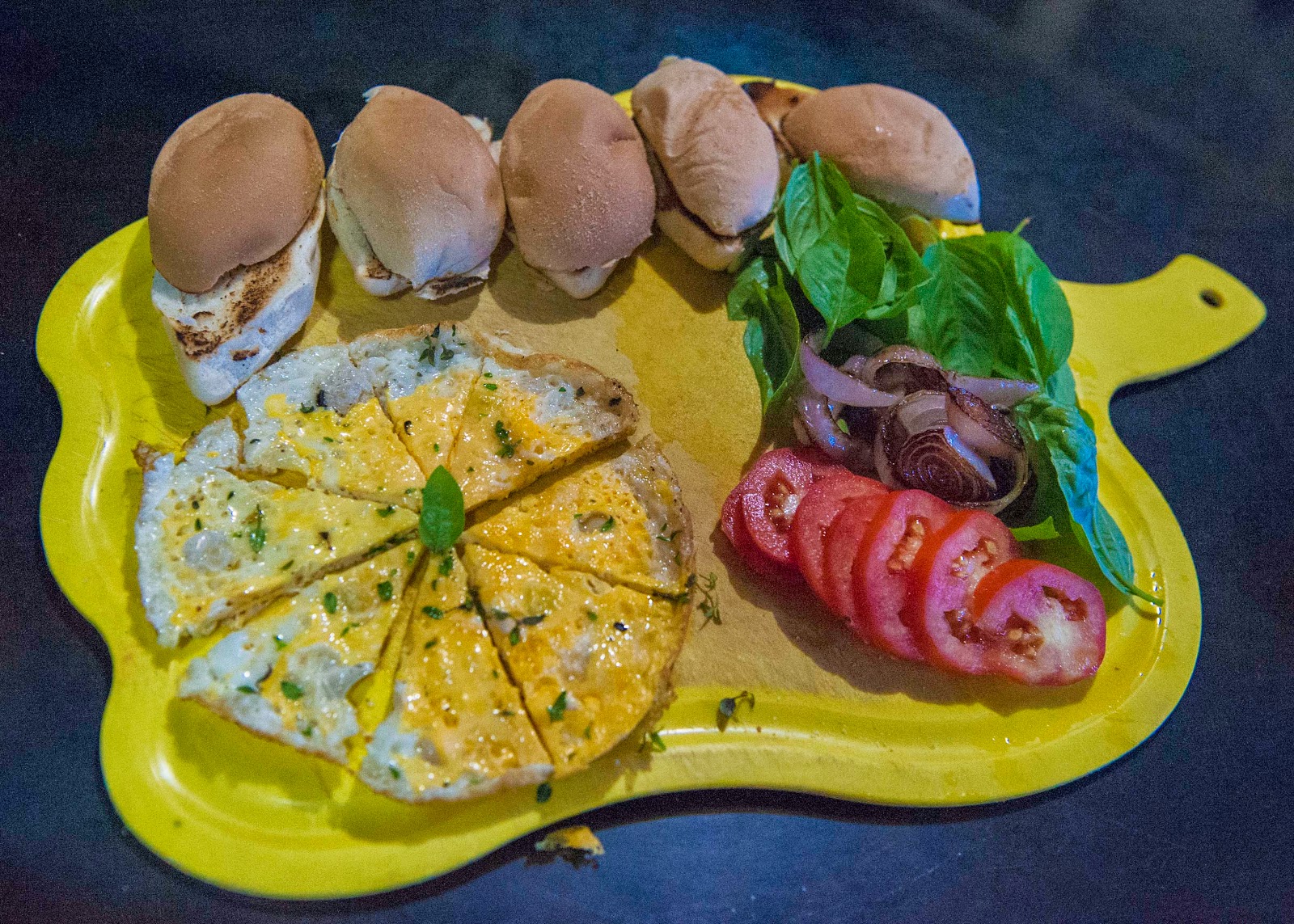
This was our dinner tonight - egg with oregano, basil, tomato, grilled onions, and bread. We purchased all this at the market next to our house for 11 pesos, or 1 peso less than the price of a Mountain Dew.

The municipality where Lauren and I live is in the heart of the agriculturally diverse region of Panay Island. The land here is fertile, the people here are knowledgable of their trade and there is fresh water almost year round.  The problem lies in that a large percentage of this food spoils and rots before it is sold. These are solely my thoughts on why this happens and do not reflect the views of the Peace Corps or any associated organization I work with.

The local community buys pre-packaged snack foods like chips, very high sugar content drinks and even higher sugar content desserts like fried donuts rolled in sugar. Calorie wise, these are acceptable foods for the men, women, and children who peddle bike cabs, work in the sugar cane plantations, rice fields and fishing boats. They need all the calories they can get. However, nutrition wise there is a huge crisis. These workers and their whole family typically eat one meal a day consisting of mainly rice with a 3 oz. piece of meat. They typically eat very little vegetables and almost never eat raw vegetables. Serving a raw veggie receives the same reaction here as serving raw chicken in the States. Given an increased budget, people tend to purchase in order of importance; rice, meat, snacks, vegetables. Children eating in these conditions do not focus in school due to malnourishment and often just sit and stare off into the distance. Now imagine putting the underweight working children with the overweight overly hyper sugar-high children who snack constantly. 

The food rots because there is no local demand. What ever demand there is, it's mitigated by the lack of income and desires of the local client base. Why don't they just sell it to a further region? There are many steps to take before this is feasible. Number one having the knowledge of how to go about this. We are working with the communities to teach them what opportunities lie outside of there known world (which is usually no further than their municipality they grew up in). Number two is start up capital. We are also teaching savings programs to help families gather the capital to expand. Finally they have to possess the ability to repeat these practices, adapt, and anticipate changes. Principles that developed countries business persons take for granted. These concepts haven't made it around the world yet. Continuing education is key here. 

I thinks it is important to point out that there are many Filipinos I have met who understand nutrition and struggle to teach those around them better eating habits. As with all social issues here, there are Filipino people doing the work very well, they're just overwhelmed.

Blog Archive